Tsunamis: Run-up and Inundation
Run-up
Except for the very largest tsunamis, the approaching wave most frequently does not break but it comes onshore as a rapidly rising turbulent surge of water choked with debris. In most cases tsunami waves appear like an endlessly onrushing tide which forces its way around and through any obstacle (hence the confusion between tsunami waves and tidal waves). They are not V-shaped or rolling waves and are not "surfable."
When the tsunami moves inland, the water level can rise many meters. In extreme cases, the water level has risen to more than 15 m (50 ft) for tsunamis of distant origin and over 30 m (100 ft) for tsunami waves generated near the earthquake's epicenter.
The large amount of water that a tsunami pushes onto the shore above the regular sea level is called Run-up, that is the maximum vertical height onshore above sea level reached by a tsunami. Run-up is the more damaging force than the huge tsunami waves as it surges inland and destroys all in it's path.
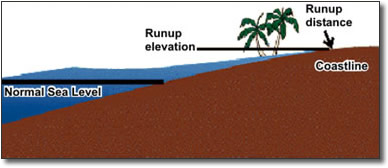
The first wave in a tsunami train doesn't always produce the highest run-up. Scientists have tried to explain why and found that a tsunami's frequency (that is how closely in time one wave follows another) combined with a shoreline's slope can result in a resonance that sends more water onshore.
A receding tsunami wave looks like a pendulum about to fall. It holds tremendous energy. If this receding wave collides with an incoming tsunami wave releasing this kinetic energy, it forces the incoming wave to mount and increase in size.
The same resonance happens when an adult pushes a child on a swing.
If the adult gives the child a push right when the child is at her highest point, she will swing higher in the next arc. Another push at just the right moment will send her even higher. In the same way, when the two tsunami waves meet at just the right moment, it causes the inbound wave to go higher on the shore.
The topography of the shoreline dictates the potential height of the wave. Flat shorelines offer little resistance and continue inland. Steep walls or cliffs will force the wave up and the larger the run-up will be.
Inundation
"Inundation" is the result of a tsunami traveling a long distance inland and is a horizontal measurement of the path of the tsunami. Flooding can occur for up to 300 meters or more covering the area with debris.
When a tsunami encounters the coastline, it breaks, surging water forward. The effect of a tsunami is defined by several factors: height, run-up height and run-up distance. Height is the crest height of the wave over the normal sea level, measured at a given point. Run-up height is measured at the maximum run-up above the normal ocean level at the tsunami time frame. Run-up distance is the maximum distance from the tide or shoreline at the time of the tsunami
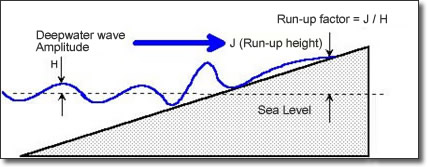
- Amplitude is approximately the maximum height of the wave above sea level when in deep water. Note that this is not the same as the "double amplitude" which is the vertical distance between the crest and the trough and is often used to describe the height of a wave.
- Run-up height is the tsunami vertical height above sea level at its furthest point inland.
- Run-up factor is the deep-water wave amplitude divided by the run-up height.
Local topography and directional travel have a great influence on the run-up effect of earthquake generated tsunamis. In Japan the run-up factor was 10 but can be as much as 25. Run-up factors of 40 have been observed in Hawaii.
There is a particular danger to seaports from tsunamis because the approach channel to the port can support a much more energetic tsunami (there is less energy dissipated or reflected as it travels over the continental shelf). Recent assessment of risk factors for tsunamis in various locations has put the run-up factor as low as 2 to 3.
For You and Your Loved Ones
With preparedness and safety measures, protect yourself and your family from earthquake risks.
Always good to prepare for an earthquake
Earthquake Warnings are a Game Changer
Stay protected, anytime, anywhere

HAPPY CLIENTS
ALERTS DELIVERED SINCE 2011